

HUL vs. Beco: What's Actually Going On in the Surf Excel Ad Fight?
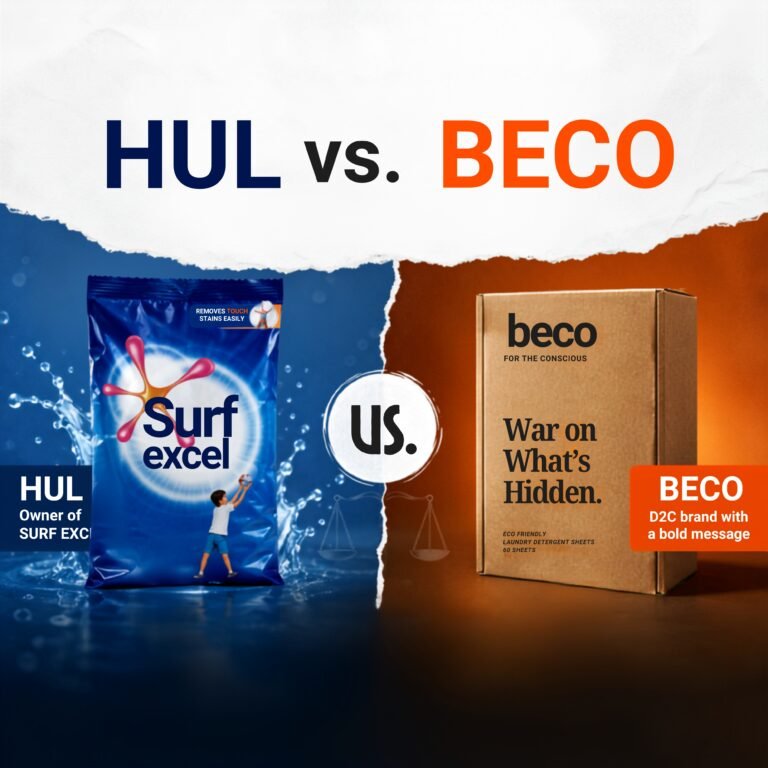
If you’ve been on Instagram lately, you may have seen Beco’s ads asking what’s “hidden” inside your detergent. That campaign has now landed the company in the Delhi High Court, facing off against one of India’s biggest FMCG names, Hindustan Unilever (HUL). Here’s the case, broken down in plain English.
The Players
Hindustan Unilever Limited (HUL) owns Surf Excel and Vim two of India’s most recognisable home-care brands.
Kwick Living (I) Private Limited is the parent company of Beco, a Mumbai-based, sustainability-focused home and personal care brand founded in 2018 by Aditya Ruia, Anuj Ruia, and Akshay Varma. Beco makes dishwashing liquids, bamboo-based products, and biodegradable garbage bags, and has raised around $13.4 million from investors.
What Sparked It
On the night of August 14, 2026 just ahead of Independence Day Beco launched a campaign called #WarOnWhatsHidden. It compared its own laundry and dishwashing liquids to Surf Excel Matic Liquid and Vim Dishwash Gel, and pointed to two chemicals: Benzisothiazolinone (BIT) and Linear Alkylbenzene Sulfonate (LAS). Beco claimed its own lab testing found BIT and LAS in Surf Excel, and LAS in Vim, and suggested these ingredients could cause skin irritation and allergic reactions. The campaign ran across social media, influencer posts, and outdoor hoardings.
Why HUL Went to Court
HUL wasn’t happy, and on August 19, it filed a suit against Kwick Living in the Delhi High Court, alleging commercial disparagement, trademark infringement, and passing off. It also objected to Beco using its registered taglines Vim’s “100 nimbuon ki shakti” and Surf Excel’s “Daag Achhe Hain” inside the campaign.
Arguing for HUL, Senior Advocate Amit Sibal told the court that Beco’s lab tests only showed the presence of these ingredients, not that the finished, ready-to-use products actually cause irritation or allergies. His point was simple: testing an ingredient in isolation isn’t the same as testing the final product people actually use. He also noted that LAS is a widely used surfactant in cleaning products generally, not something unique to Vim. HUL further pointed out that Beco released the campaign late at night, right before a public holiday, when the company couldn’t rush to court for urgent relief. As Sibal put it in his submissions, comparative advertising is fine but a brand “cannot cross the Lakshman Rekha of calling your competitor’s products bad.”
Beco's Side
Beco, represented by Senior Advocate Chander M Lall, asked the court for time to respond. Speaking to the media separately, Beco co-founder Aditya Ruia said the campaign’s claims were tested by an NABL-accredited independent laboratory and checked against ASCI and CCPA advertising guidelines before launch. According to Beco, its testing found 277 mg/kg of BIT and LAS levels above 10% in the Surf Excel sample it examined. The brand has framed the campaign as part of a longer-term push for ingredient transparency in the home-care category, not a one-time attention grab.
What the Court Has Done So Far
At the first hearing on August 19, Justice Anup Jairam Bhambhani did not grant HUL an interim injunction. Instead, he issued notice to Kwick Living and directed Beco to file its formal reply by August 20, with the matter listed for further hearing on August 21. In short: as things stand, no order has stopped Beco’s ads the court simply wants to hear both sides properly before deciding whether any restraint is needed.
Why This Case Matters
India’s courts have said for years that comparative advertising itself is legal brands can compare themselves to rivals. What they can’t do is cross into disparagement, denigrating a competitor’s product rather than just promoting their own (courts have made similar calls in past HUL disputes with Colgate and Reckitt Benckiser). This case will test where that line sits when a smaller, digital-first D2C brand takes on an FMCG giant using an ingredient-transparency angle a trend we’re likely to see more of.
This matter is still before the Delhi High Court and developments are ongoing. This post reflects the position as of the last reported hearing.


