
EUROPEAN PATENT REGISTRATION
European Patent Registration: Complete Step-by-Step Guide to Filing in Europe
Protecting your invention through european patent registration is one of the most strategic moves an innovator or business can make. A single European patent application, filed through the European Patent Office (EPO), can protect your invention across up to 40 member states with one streamlined process (as of June 2026, following Moldova’s accession, the EPC now covers 40 contracting states). This guide walks you through every stage of the patent filing process in Europe from preparing your application to achieving full grant along with timelines, expert tips, and answers to the most common questions.
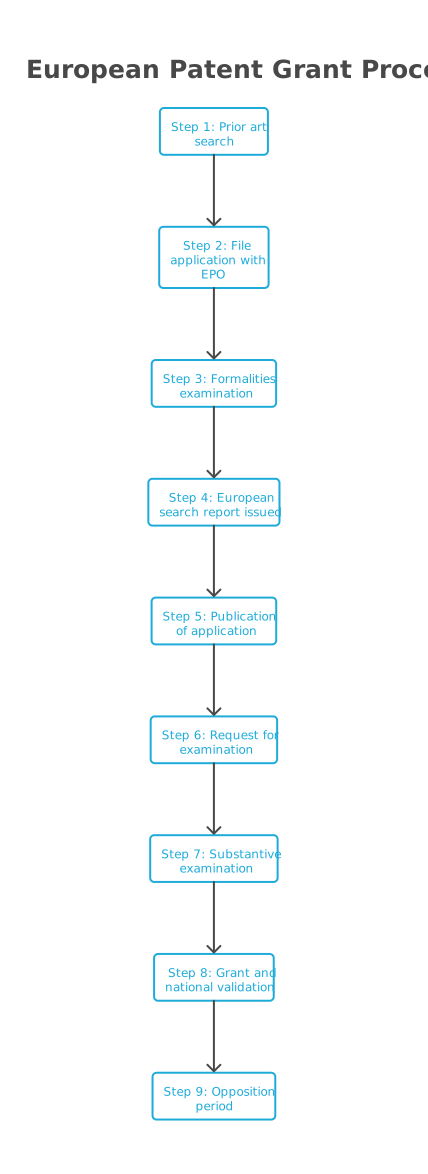
Step-by-Step Timeline for Patent Filing in Europe
| Step No. | Action |
|---|---|
| Step 1 | Prior art search |
| Step 2 | File application with EPO |
| Step 3 | Formalities examination |
| Step 4 | European search report issued |
| Step 5 | Publication of application |
| Step 6 | Request for examination |
| Step 7 | Substantive examination |
| Step 8 | Grant and national validation |
| Step 9 | Opposition period |
Detailed Explanation of Each Step
Before starting the patent filing in Europe, conduct a thorough prior art search to verify that your invention is new and inventive. The EPO’s free database, Espacenet, allows you to search millions of patent documents worldwide. This step saves time and money by identifying potential obstacles before you invest in formal filing.
Your invention must meet three core patentability criteria under the European Patent Convention (EPC):
- Novelty – it must not have been disclosed publicly before your filing date
- Inventive step – it must not be obvious to a person skilled in the field
- Industrial applicability – it must be capable of practical use
The European patent application must include the following components:
- Request for grant (EPO Form 1001)
- Description of the invention in full technical detail
- Claims defining the scope of protection sought
- Abstract summarizing the invention
- Drawings (if necessary to understand the invention)
Applications can be filed in English, French, or German. You can file online via the EPO’s MyEPO portal using the Online Filing 2.0 (OLF 2.0) tool (the legacy eOLF software has been discontinued; OLF 2.0 is now the only supported online filing system), by post, or in person at EPO offices in Munich, The Hague, Berlin, or Vienna. Note that since October 2025, the EPO accepts colour drawings where colour is necessary to understand the invention. Upon filing, you receive an official filing date, which establishes your priority date critical for protecting your invention against later disclosures.
Step 3: Formalities Examination
Once your application is received, the EPO conducts a formality check to ensure all required elements are present and correctly formatted. If anything is missing or incorrect, the EPO will issue a communication giving you a non-extendable two-month period (from notification of the communication) to correct the deficiencies. Failure to respond within this two-month deadline can result in the application being deemed withdrawn.
Step 4: European Search Report and Written Opinion
One of the most important stages in the patent filing process in Europe is the European search report. An EPO examiner searches all relevant prior art and issues a report listing documents that may affect the novelty or inventive step of your claims. Alongside this, a Written Opinion is issued, providing the examiner’s preliminary view on patentability.
Reviewing this report carefully is essential. You may amend your claims or description in response to any objections raised before requesting full substantive examination.
Approximately 18 months after your filing date (or priority date), your application is published in the European Patent Bulletin. This makes the application publicly visible worldwide. From this point, third parties can submit observations on patentability, though they cannot oppose the application until after grant.
Step 6: Request for Substantive Examination
You must file a Request for Examination within six months of the search report being published. If you do not file this request in time, the application is automatically deemed withdrawn. Important: designation fees for the EPC member states in which you seek protection must also be paid within six months of the date on which the European Patent Bulletin mentions the publication of the European search report; failure to pay will result in automatic loss of rights in those states. If you wish to accelerate examination, the EPO’s PACE (Programme for Accelerated Prosecution of European Patent Applications) can significantly reduce processing times. PACE may be requested at the same time as filing the Request for Examination at no additional cost. During substantive examination, an EPO examiner reviews whether your invention fully meets all requirements of the European Patent Convention. Multiple rounds of communication between you (or your representative) and the EPO may occur.
Once the EPO is satisfied that all requirements are met, a decision to grant is issued. The EPO first issues a communication under Rule 71(3) EPC setting out the text intended for grant. You must respond within four months (this deadline is non-extendable) by approving the text, paying the grant fee, and filing any required translations of the claims. Once these requirements are met, the patent is granted and published in the European Patent Bulletin. You then have a short window to pay the grant fee and provide translations where required.
Step 8: National Validation
After grant, you must validate the European patent in each country where you want protection to take effect. Each member state may have different national requirements, including filing translations and paying national fees typically within three months of the grant date. Failure to validate in a country means the patent will not be enforceable there.
Step 9: Opposition Period
Any person can give notice of opposition within 9 months from publication of the grant mention. Opposition division may reject opposition, maintain patent amended, or revoke it.
Why Choose Us for Your European Patent Registration?
Navigating the European patent registration process without expert guidance can be costly. Here is why clients trust us:
- Experienced Patent Attorneys – Our team includes qualified European Patent Attorneys with deep technical and legal expertise across all industries.
- End-to-End Service – We handle everything from initial patentability searches through to grant and multi-country validation.
- Cost Transparency – No hidden fees. We provide clear estimates for official EPO fees and our professional charges upfront.
- Strategic Counsel – We help you draft strong, broad claims that maximize the commercial value of your patent.
- Global Network – Through our partner network, we can seamlessly extend your protection internationally via PCT filings.
- Fast Response Times—Missed deadlines can be fatal to a patent application. Our rigorous docketing system ensures nothing falls through the cracks.
The typical timeline for patent filing in Europe from application to grant is 3 to 5 years, depending on the complexity of the invention and how efficiently examination proceeds.
Applicants not residing in an EPC member state are legally required to be represented by a European patent attorney. For residents of EPC states, representation is strongly recommended given the complexity of the patent filing process in Europe.
A European patent requires country-by-country validation after grant, while a unitary patent (introduced June 1, 2023) provides uniform protection across 18 participating EU member states with just one validation step, significantly reducing costs.
Critical: You must request unitary effect within 1 month of the grant (strict, non-extendable deadline) plan this in advance.
You have the right to appeal a refusal to the EPO's Boards of Appeal, an independent judicial body. The appeal process adds time and cost but can reverse an incorrect refusal.