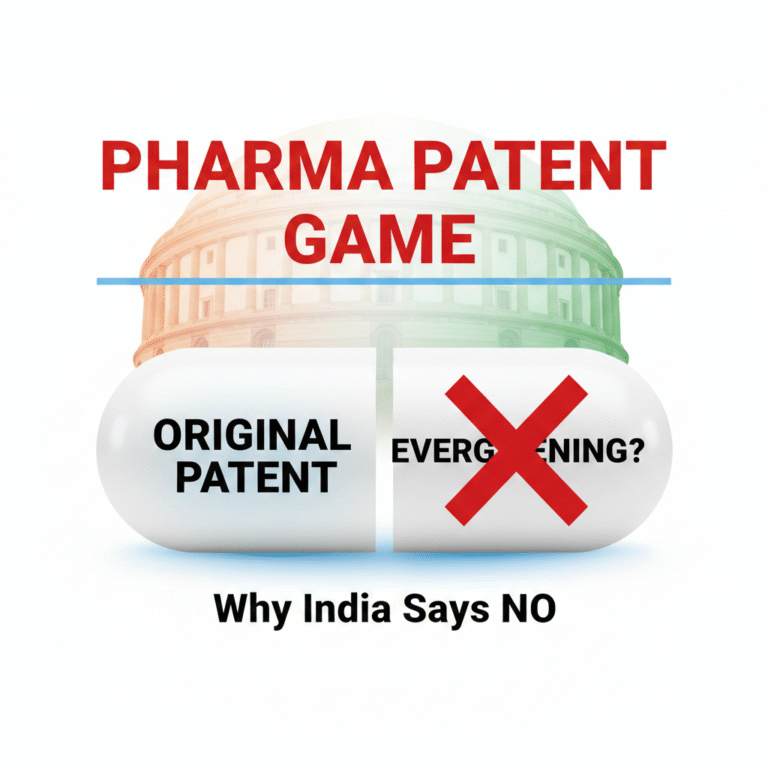
Imagine a popular drug making billions of dollars. The clock for the 20-year patent period is running out, and generic drug companies are preparing to launch their product. The price of the original will drop significantly, and patients will be able to get a better night’s sleep. As soon as exclusivity appears to be over, pharmaceutical companies engage in a familiar practice known as evergreening. They make small changes to the original product; as a result, they can continue to sell their product at a premium.
Evergreening isn’t simply an issue of profit. It’s a life-and-death struggle between the forces of innovation and consumer access to medications. In this global battle, India has elected to withdraw from participating. This blog discusses the practice of evergreening, the ongoing lawsuits, and how Section 3(d) of the Indian Patent Act provides hope of access to affordable medicines for people throughout the world.
The Sneaky Art of Patent Evergreening
Generic drugs substantially reduce the price of brand-name pharmaceuticals when their patents expire (often by 90%). For several patients, this means the potential difference between life and death.
Evergreening keeps the monopoly alive longer than expiration. Evergreening uses the secondary patent application as a tool for pharmaceutical companies to obtain further patent protection by way of inventions that do not offer true technological advancements, such as:
- New polymorphic/crystalline formulations of drug compounds.
- Combination formulations of multiple drugs.
- Alteration of the dosage form; or,
- Pharmaceutical companies utilize previously known pharmaceutical compositions for new therapeutic purposes.
Although the parent compound remains patentable, there is no longer any time limit for enjoying the exclusivity afforded by the patent(s). Critics see the practice of evergreening as a loophole to allow pharmaceutical companies to restrict competition and artificially inflate drug prices. The defenders believe it is part of the process of incremental innovation. However, for instance the ethical dilemma associated with cancer treatments priced at ₹70,000 per year, while generics cost significantly less, becomes inescapable.
India’s Ironclad Shield: Section 3(d)
India has long been referred to as the “Pharmacy of the World” due to its ability to produce nearly 20 percent of generics worldwide. When India updated its Patents Act in 2005 on the basis of TRIPS, it created a wholly new concept by introducing the idea of Section 3(d).
Section 3(d) of the Patents Act prevents the granting of patents for new forms of already-known compounds, unless those new compounds possess a significantly increased level of therapeutic effectiveness over the known compound.
Merely being a different-looking version of the same compound is not sufficient to qualify as a new product eligible for patent protection. Merely improving the rate of absorption or stability, for example, is not sufficient to justify granting a patent. Therefore, the courts require that improved clinical results or improved clinical outcomes occur through additional clinical evidence. This is not anti-innovation; this is about protecting public health.
Between the years 2024 and 2025, India’s Minister of Commerce, Piyush Goyal, made very plain during trade discussions with the United States and Switzerland as to what India’s position would be regarding this issue: India would not permit patent evergreening.
The outcome?
- A decrease of approximately 15 percent in patent grants by 2024
- An increase in the number of refusals of patent applications
- A tightening of scrutiny of patent applications
- An emphasis on innovation, so long as it creates real value.
Courtroom Blockbusters: Evergreening on Trial
India’s courts have turned patent battles into edge-of-your-seat dramas, pitting Big Pharma’s monopoly dreams against everyday patients’ right to affordable drugs. These aren’t dusty legal files they’re real-life showdowns exposing evergreening’s tricks: minor tweaks like a new crystal shape or salt form to dodge patent expiry and keep generics out.
- Novartis vs. Union of India: The Glivec Wake-Up Call (2013)
Novartis’ leukemia drug Glivec (imatinib mesylate) was a miracle, but its original patent expired. They tried evergreening with the “beta crystalline form”-just a fancier powder shape claiming slightly better absorption (bioavailability). No proof it worked better for patients, though.
India’s Supreme Court slammed the brakes: Under Section 3(d), you need enhanced therapeutic efficacy-real clinical wins like fewer side effects or faster healing not lab stats. Rejected! Generics flooded in at 1/10th the price (₹8,000 vs ₹1.2 lakh monthly), saving millions of cancer patients. This case made Section 3(d) world-famous as an anti-evergreening weapon.
- Roche vs. Cipla: Tarceva Turf War (2012)
Roche’s Tarceva (erlotinib) fought lung cancer. As generics eyed the market, Roche sued Cipla for copying their version, Erlocip, claiming patent infringement on the core compound—not a tweak, but exclusive stretch attempts.
Delhi High Court single judge sided with Cipla (public health angle), but Division Bench flipped for Roche yet denied injunction since patent expired soon (2016). Evergreening lesson: Courts probe if claims block genuine copies, balancing innovation with access
Will India Ever Change Course? Unlikely.
While the Patent Amendment Bill, 2025, aims to improve the speed at which patents are granted, expand support for start-ups, and develop green technology, Section 3(d) is not included in these changes. Why is this?
Because of India’s Health Care Challenges:
- A Population of 1.4 billion
- Need for Affordable Generic Drugs
- World’s Source of Medicines
While the EU and US continue to advocate for reduced standards through trade agreements, India is safely standing behind the Doha Declaration’s flexibilities and rejecting all temptation to alter Section 3(d).
If Section 3(d) Were Diluted:
- Prices for Medications Would Skyrocket
- All Public Health Objectives Would Be Compromised
- India’s Place as the Global Leader in Medicine Would Be Undermined
Why Evergreening Still Ignites Debate
The delicate trade-off in patent law is whether you reward innovation while at the same time allowing people to live. The balance between rewarding genuine innovation and preventing the death of people is a difficult one, and it continues to be challenged by countries like India with innovative models pressuring pharmaceutical firms to create new drugs based on true innovation rather than just extending their monopoly on the market.
-Authored by Bhumika Mukherjee